

How Rate Shoppers Integrate With Your TMS for Seamless Shipping
Posted on June 1, 2026
Written by Mickey Powers

Most shippers pull shipment data from the warehouse management system (WMS), manually key it into a rate comparison tool, evaluate carrier options and then enter the winner back into the transportation management system (TMS). Manual data entry creates opportunities for dimensional errors or incorrect service level selections, which can trigger billing disputes and accessorial charges.
When a TMS and rate shopper operate as disconnected systems, each shipment requires duplicate effort. Integration creates a direct data flow between order management and carrier selection.
The Hidden Costs of Manual Shipping Processes
Manual rate comparison creates compounding challenges across thousands of shipments annually. When your team manually enters package dimensions, weights and service requirements, they work with snapshot data that may already be outdated. Freight rates fluctuate based on capacity, fuel surcharges and seasonal demand.
Data accuracy directly impacts your bottom line since a transposed digit in package weight or an incorrect service level selection can result in billing adjustments and disputed charges. Companies processing high shipment volumes can reclaim thousands of hours annually by automating rate comparison and data flow across systems.
These labor hours represent direct savings in wages and benefits, plus the value gained when skilled logistics professionals shift focus from repetitive tasks to strategic carrier negotiations.
What Is a Rate Shopper?
A rate shopper is a comparison tool that queries multiple carriers simultaneously to identify the optimal rate and service combination for a specific shipment. It evaluates contract rates, spot market rates and publicly available tariffs, then ranks options based on cost, transit time or other criteria you define.
The accuracy of the incoming freight information determines the reliability of rate quotes. Stand-alone rate-shopping tools require manual data entry for every comparison because the user must provide the shipment details needed to generate accurate quotes.
The Role of a Transportation Management System (TMS)
A transportation management system serves as the central repository for all shipment-related data used for rate shoppers. Critical information maintained by the TMS includes the following:
- Origin and destination addresses: Complete routing information for every shipment.
- Package dimensions and weights: Verified measurements that determine freight class and pricing.
- Commodity classifications: Product codes that affect carrier rates and handling requirements.
- Service level requirements: Delivery deadlines and special handling instructions.
- Customer-specific shipping instructions: Account preferences and delivery constraints.
The TMS pulls order data from upstream systems, such as your enterprise resource planning (ERP) platform or warehouse management system, and orchestrates the entire shipment life cycle from carrier selection through delivery confirmation and freight payment.
A direct data connection between your TMS and rate shopper enables fully automated carrier selection. When an order is ready to ship, the workflow proceeds through four stages that ensure optimal carrier selection:
- Data transmission: Complete, verified freight information flows automatically from the TMS to the rate shopper.
- Rate comparison: The rate shopper queries carriers and identifies the optimal option based on your predefined business rules.
- Decision return: The recommended carrier and rate flow back to the TMS.
- Execution: Label generation, order status updates and carrier notification all happen automatically.
By leveraging actual package dimensions at packing, real-time market rates and accurate delivery requirements, rate comparisons ensure immediate, precise carrier selection for every shipment.
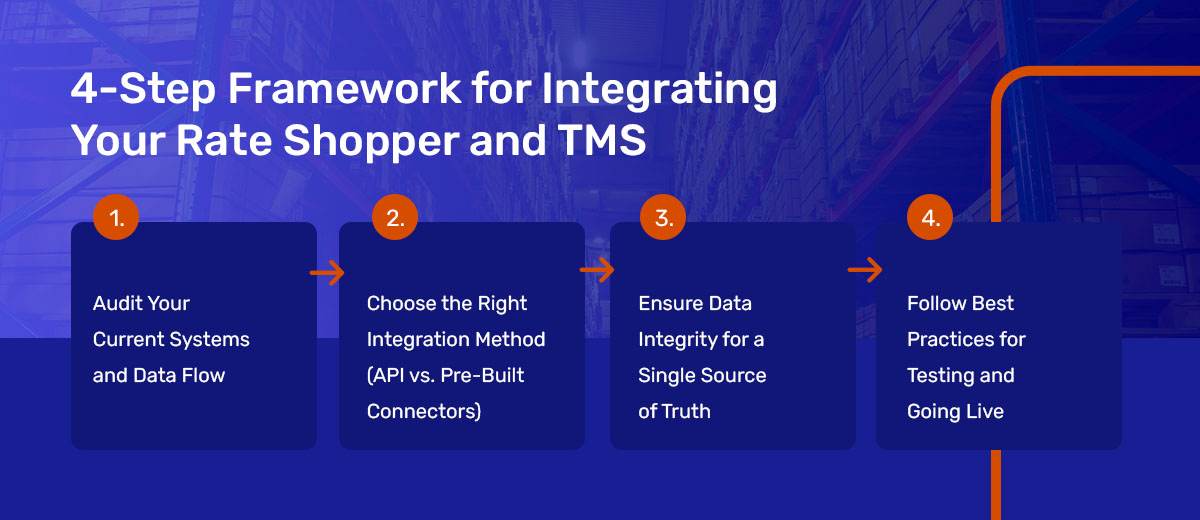
4-Step Framework for Integrating Your Rate Shopper and TMS
Successful integration requires deliberate planning and disciplined execution.
1. Audit Your Current Systems and Data Flow
Begin by mapping your current technology ecosystem. Document where freight information originates, how it moves between systems, who enters data manually and where data quality opportunities exist. Identify your current TMS, warehouse management system, order management system and any middleware or integration platforms already in place.
2. Choose the Right Integration Method (API vs. Pre-Built Connectors)
Two primary integration methods exist for connecting your systems. Application programming interface (API) connections offer flexibility for custom workflows and integration with proprietary systems, but they require development resources and ongoing maintenance.
Pre-built connectors provide faster implementation for standard platforms like Shopify, NetSuite or SAP, with streamlined setup processes. Consult resources on the right integration method to evaluate which approach aligns with your technology stack.
3. Ensure Data Integrity for a Single Source of Truth
Accurate, complete data is foundational to the value of integration. Implement validation rules to verify address completeness, package dimensions and commodity code accuracy before shipments enter the rate shopping workflow. Establish governance processes that define who owns data quality for each field, how discrepancies are resolved and what validation checkpoints exist.
4. Follow Best Practices for Testing and Going Live
Run the integrated system in parallel with your existing process for a defined testing period. Compare rate recommendations, validate that freight information flows correctly and confirm that selected carriers receive accurate tender information.
Use this parallel operation to identify edge cases, refine business rules and build user confidence in automated recommendations.
Key Benefits of Integration Between Your TMS and Rate Shopper
Integration between your TMS and rate shopper delivers immediate freight cost reduction alongside compound benefits across labor efficiency, carrier performance and procurement leverage.
Drastically Reduce Manual Data Entry and Labor Costs
Automation eliminates repetitive data entry tasks for operations processing hundreds or thousands of shipments daily. Your logistics team can shift focus from transactional data entry to exception management and strategic analysis. Staff can focus on carrier performance analysis, contract negotiation preparation and network optimization initiatives.
Access Real-Time, Market-Based Rates to Stop Overpaying
Contract rates offer predictability but adapt slowly to market shifts. When freight capacity loosens or fuel prices drop, your contracted rates may exceed spot-market rates.
Integration allows the system to evaluate both contracted and spot rates for every shipment, automatically selecting the most cost-effective option while respecting delivery commitments. The system continuously monitors market conditions to capture the best available pricing for each shipment.
Improve Carrier Performance and On-Time Delivery
Performance tracking at the shipment level enables data-driven carrier selection. The integrated system captures on-time pickup rates, transit time compliance and damage claims by lane and service type, then feeds this intelligence back into selection algorithms.
Carriers with proven reliability on specific lanes earn preference in future assignments, creating a performance-driven carrier mix that optimizes for both cost and service quality.
Gain True Visibility for Stronger Carrier Negotiations
Contract negotiations become fact-based discussions when you have comprehensive shipping analytics. You can demonstrate to carriers exactly which lanes they excel in for price, where their service quality stands out, and how much volume they receive from your operation. Hard data on rate competitiveness, on-time delivery and total freight spend by carrier replaces anecdotal discussions. Organizations using this approach for contract optimization report improved contract terms and more transparent pricing structures.

Quantify Your Savings With a Broussard Logistics Assessment
An integrated TMS and rate shopper creates a foundation for data-driven shipping decisions. Broussard Logistics offers a complimentary freight assessment that quantifies the gap between your current state and optimized performance.
We analyze your shipping data to identify opportunities to improve billing accuracy, assess carrier selection patterns and explore automation potential. Our contract optimization services include preaudit capabilities that catch overcharges before payments are issued.
Request a complimentary assessment to see where integration can deliver measurable ROI in your operation.