

Parcel vs. LTL — What Are the Differences?
Posted on August 28, 2026
Written by Mickey Powers

What Is Parcel Shipping?
Typically, business owners choose parcel shipping when they need to send smaller packages that drivers and operators can lift without assistance. This option involves more checkpoints and transfers, allowing businesses to track their shipments through each stage. However, small items are more likely to get lost or damaged during transfer, making this method riskier for some businesses.
Parcel delivery is an excellent option for those looking for a flexible and budget-friendly pickup process. Shipping is often more affordable because packages are smaller. Additionally, drivers can use drop-off locations, such as a post office, to deliver packages if the recipient prefers.
Understanding LTL Trucking
Less-than-truckload shipping is a way to transport larger packages and products. Companies that routinely ship uniquely shaped packages or bulky orders can rely on LTL for safe and efficient delivery.
Businesses often place LTL shipments on pallets, allowing products to move together and ensuring the recipient receives their entire order at once. This process involves fewer checkpoints, so businesses have less visibility over shipment movement than with parcel shipping. However, a significant advantage of this option is that fewer people handle the products, minimizing the chances of damage or loss.
LTL is cost-effective when transporting many products to the same location. Even if the packages are smaller, the per-shipment cost is lower because the items travel together. For example, shipping a pallet of five boxes with LTL is more cost-effective than sending five separate packages with parcel shipping.
Products that may use LTL include:
- Car accessories or parts
- Electronic devices
- Lumber, tiles and other construction materials
- Furniture such as tables and couches
- Large appliances like washing machines and refrigerators
What’s the Difference Between Parcel and LTL Shipping?

Parcel shipping is best for transporting small packages from businesses to individuals, while LTL is ideal for bulk and larger items from suppliers to businesses. However, some nuanced differences make them advantageous for more unique circumstances.
- Pricing model: While parcel shipping pricing includes factors like shipping speed, dimensions, weight and destination, LTL variables are distance, weight, and freight class. Freight class reflects a package’s details, such as handling requirements, liability, density and storability. Easier-to-move shipments reduce LTL costs.
- Product weight: One of the most significant differences between parcel shipping and LTL is the weight requirement. Though specific requirements vary by carrier, small parcel shipping is typically available for packages under 150 pounds. Alternatively, LTL packages can weigh between 150 and 15,000 pounds and do not require a full truckload.
- Tracking and checkpoints: While parcel shipments move from one hub to the next until they arrive at the proper destination, LTL shipments have less visibility. You can easily track packages’ movement because workers scan and update the status at every stage. However, products shipped with LTL move directly from the business to the customer, eliminating checkpoints and reducing updates while optimizing shipping costs.
- Damage risks: Though some business owners enjoy the increased visibility of parcel shipments, the number of checkpoints and handlers can also present a unique issue. The risk of loss or damage increases with more people handling small packages. Alternatively, LTL shipments often travel on pallets and have minimal, if any, exposure to checkpoints, increasing the likelihood that the products arrive in their anticipated condition.
- Transit: You can find choices like next-day, same-day or two-day shipping for parcels. These packages’ small sizes make them easy to move, and they do not require loading equipment. Alternatively, LTL shipments may need forklifts or similar equipment for loading and unloading processes, adding time to the shipping process. Depending on the starting and ending locations, LTL shipments can take several days to a week to reach their final destinations.
- Residential delivery: Parcel shipping is common for residential needs, while LTL is a direct-to-consumer method that can better serve businesses. Though you can meet some residential needs with LTL, you may encounter additional fees. For example, you must consider how the recipient will unload the package, whether they will need special equipment and if the residential area permits the space necessary for truck movement.
LTL vs. Parcel Cost Comparison
Parcel shipping costs are typically cheaper due to the item’s weight and dimensions. But that only remains true to a certain point. Every other difference between them also affects their price.
Parcel Shipping Cost Breakdown
Carriers bill based on whichever is higher — actual weight or dimensional weight — plus the delivery zone, which increases costs alongside distances.
Surcharges also impact the cost of parcel shipping. You’ll incur these when your package requires additional handling for these reasons.
- Misclassified packages: Misclassification happens when carriers audit your package and notice that its dimensions, weight or delivery details are incorrect.
- Your parcel is in a near-limit box: Carriers may apply a surcharge if your package is near their weight or dimension thresholds.
- Oversized packages: Once your package exceeds a carrier’s limit but still falls within their absolute maximums, they will charge you extra to deliver the item.
- Accessibility issues: Carriers apply delivery area surcharges to parcels addressed to remote or rural recipients.
Damages can also impact your costs more indirectly. Parcel shipments involve multiple handoffs, thus increasing the risk of in-transit damage. If a customer receives a damaged parcel, you’ll need to issue a refund or send a replacement.
LTL Shipping Cost Breakdown
LTL shipping costs depend on the density, freight class, handling requirements and weight. The National Motor Freight Classification system provides definitions to help you determine the class and calculate the estimated price.
You must also know the freight class to obtain a bill of lading or rate quote. A bill of lading will provide information regarding the carrier, shipper and person signing to receive the goods. Since LTL does not offer transit visibility, this document serves as a receipt and shipping label, aids in calculating charges and provides evidence against any claims or disputes that arise during transit.
Most of the extra costs associated with LTL stem from additional handling requirements. Misclassifications, returns, liftgate services, density errors, limited access or residential locations, appointment deliveries and inside deliveries all contribute to the shipping price. Damages can also impact your bottom line with LTL shipping. However, it’s less likely due to the palletized packaging and near-direct delivery.
Misclassification with LTL follows the same rules as parcel shipping — data entry errors lead to fees. However, these classifications also affect returns. If your package’s classification is close to LTL requirements, you can avoid overage charges caused by customer repackaging by shipping the return as LTL.
Which Is Better — Parcel or LTL?
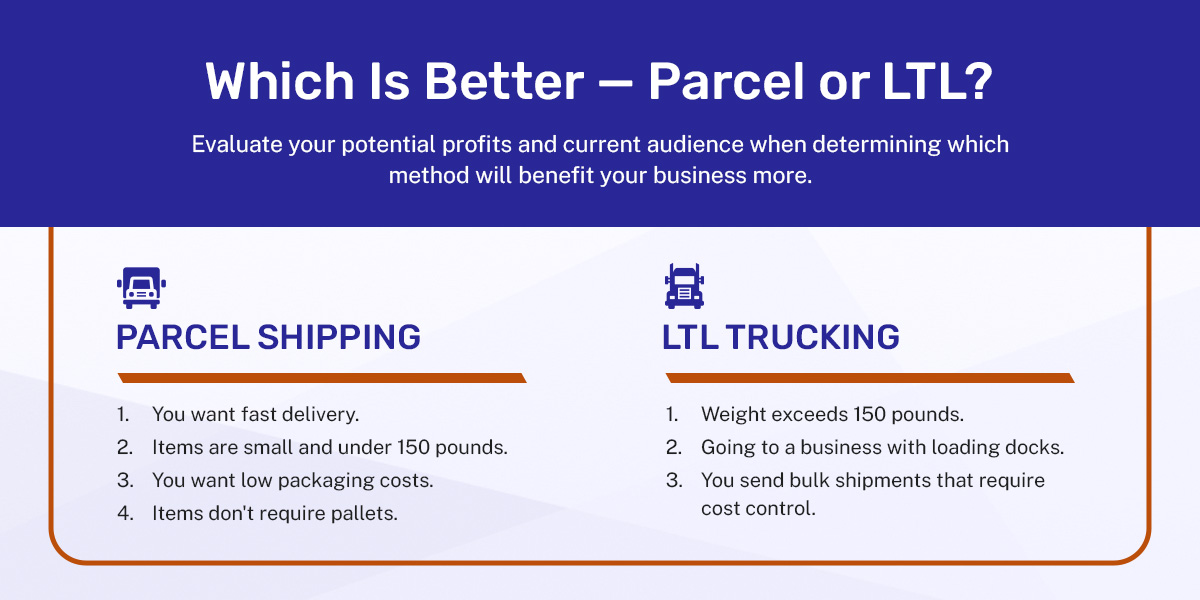
Evaluate your potential profits and current audience when determining which method will benefit your business more.
Parcel shipping is best when:
- You want fast delivery.
- Items are small and under 150 pounds.
- You want low packaging costs.
- Items don’t require pallets.
- Your parcels are going to a business without a loading dock or a residential address.
LTL trucking is ideal when:
- Palletized transport is beneficial and the package weight exceeds 150 pounds.
- The package is going to a business with loading docks.
- You send bulk shipments that require cost control.
Streamline Your Shipping With Broussard Logistics
At Broussard Logistics, you can find the technology and services you need to reduce and manage freight costs. Our team has over four decades of industry experience saving customers time and money. Whether you need LTL optimization services, parcel contract solutions or a combination of services to streamline your operations, we’ve got you covered with our comprehensive offerings.
We provide ongoing data monitoring, benchmarking, detailed carrier analyses and contract negotiation support. These solutions empower you to make informed decisions with market data, level the playing field to remain competitive and ensure you have ongoing support.
We will help you avoid overspending, optimize rates, enhance your customer experience and boost operations to grow your business. Rely on us when you’re ready to increase efficiency and reduce transportation costs. Contact our team to find a customized solution.