
The Hidden Costs of Not Auditing Your Parcel Billing
Posted on September 29, 2025
Written by Mickey Powers

Auditing your parcel invoices identifies savings opportunities and improves operational efficiency. Whether you’re a large or small business, the cost of inaccurate billing can compound. Common errors include incorrect rates, wrongful charges, erroneous residential fee, Non-proof of Shipment, Non-proof of delivery duplicate billing. Oversized packaging also adds unnecessary costs. Without a regular audit, it’s easy to go over the budget for your shipping expenses.
An automated auditing platform streamlines the process for you. It easily identifies where you can optimize and cut down on costs. You can also use your historical data on any errors to renegotiate your contract for better terms. Use this article as your guide for understanding how much money you may be losing by not auditing parcel invoices.
Hidden Parcel Billing Costs
The hidden cost of not auditing parcels includes inaccurate billing, overcharging, inefficient packaging and unrewarding contracts. Here’s how they impact your bottom line:
1. Invoice Errors
Up to 20% of e-commerce packages fail to be delivered on the first attempt. In 2021, the U.S. Postal Service also reported that the largest failures in its deliveries happened in transit. This makes accurate delivery information essential. Delivery failures and unsatisfied customers impact the costs. Apart from misrouted packages, other costly errors include:
- Incorrect rates and discounts: You may have been charged a rate different from what’s in your contract, or your negotiated discounts, such as volume discounts, may not have been applied correctly.
- Saturday surcharge errors: Your weekday deliveries may have been charged a Saturday rate.
- Duplicate charges: You may have been charged twice for the same delivery, especially with multi-package shipments.
- Billed unshipped packages: Unshipped packages shouldn’t garner delivery charges.
- Package misclassification: Misclassifying packages impacts costs, especially related to taxes.
These errors often result from incorrect data entry into shipping systems, potentially due to a manual audit or the lack thereof. Overlooking contract clauses can also lead to surprises.
2. Errors in Accessorial Charges
Accessorial charges are additional carrier fees that increase shipping costs. These charges are for services beyond the standard pickup and delivery. They are added to the base rate, but often hidden. The fees may be applied post-shipment and not at the quoting stage.
The following may incur accessorial charges:
- Residential deliveries
- Remote or hard-to-reach delivery areas
- Large, heavy packages or those that require special handling
You may also be charged a fuel surcharge and address correction fees, which you’ll find within invoice line items. Such fees can already be costly even if accurate. Overcharging further balloons the costs.
3. Excessive Packaging
Carriers often use a dimensional weight pricing model, known as DIM weight, when calculating shipping costs. The price is based on the package’s volume instead of its true weight, meaning carriers consider the space the package takes up in the vehicle. To get the billable weight, they divide the volume by a DIM divisor, which depends on the carrier and can be negotiated. You’ll be charged the billable DIM weight if the number is higher than the actual weight.
The larger the package, the greater the cost. Therefore, it’s better to avoid oversized packages. Even a few extra inches can multiply the fee. Miscalculating package dimensions also leads to overcharges. You can identify how much your packaging is costing you under the invoice’s billable weight column.
4. Unrewarding Contracts and Carriers
Consider your accumulated experience with your current carrier and whether you have unfavorable terms. Maybe you don’t get volume discounts, or you’re susceptible to hidden fees. Some carriers offer negotiated rates, especially if you’ve encountered past inaccurate billing.
Each carrier has its strengths regarding the routes and shipments. Some may deliver locally, regionally, nationally or globally. Find one that delivers where your primary customers and suppliers are. They should also have the equipment to safely transport your packages. Damaged products and refunds add to the cost.
Also, if carriers don’t care about your customers, they may negatively impact your customers’ experience. This affects your brand and customer loyalty in the long term.
How Parcel Billing Audits Help
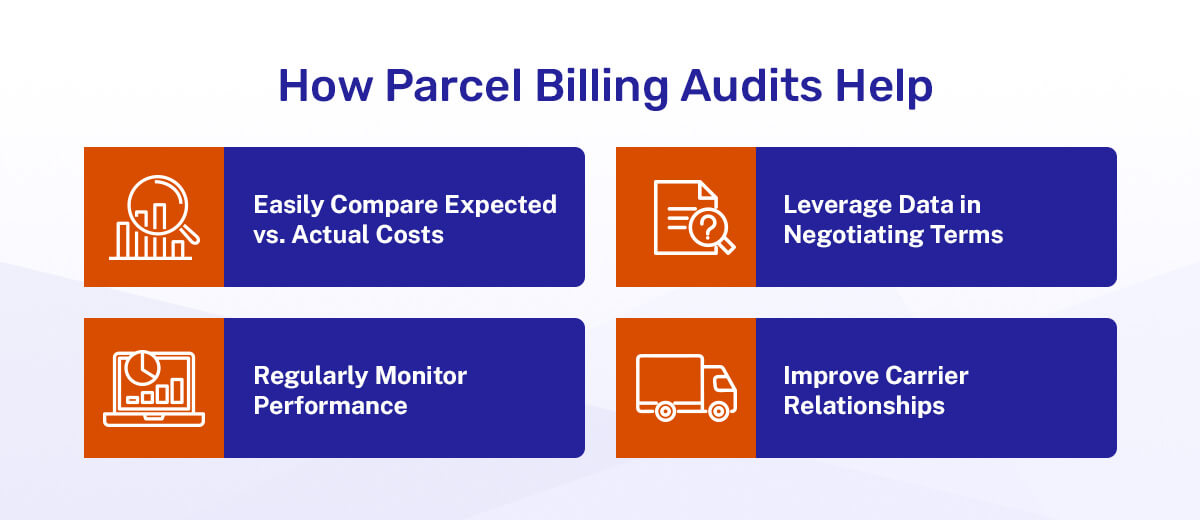
Parcel billing audits ensure you only pay for the services you received. They also help you get refunds when applicable. Errors quietly eat into your profits, with 4% of invoices being incorrect. By regularly checking for inaccuracies, you can reinvest potential savings back into your business. Here’s a breakdown of how auditing benefits you:
1. Easily Compare Expected vs. Actual Costs
A parcel shipment audit lets you compare actual billing to contract terms. You can determine if the services listed are correct and if negotiated discounts were applied. Note any discrepancy so you can ask for refunds later. You can also check if the right accounts were billed, ensuring the correct allocation of your budget.
Automated auditing software aggregates data across your contracts to identify discrepancies. Manual auditing is susceptible to human error and can take longer to complete. The benefits of professional parcel audit services include access to such software. Plus, you’ll get expert insights on how to save on shipping costs.
2. Regularly Monitor Performance
Auditing helps you track key metrics, such as on-time deliveries and damage rates. This lets you make informed decisions on how to improve your shipping process and prevent past mistakes. For instance, you may need to adjust the shipping price for certain locations. You may also redesign your packaging to save on billable weight. You may even consider switching carriers with an increase in accessorial charges due to delivery distances and handling.
Damaged items are usually misdelivered or delivered late. Regularly monitoring shipments lets you plan for better delivery accuracy and prevent parcel losses.
3. Leverage Data in Negotiating Terms
With access to historical data, you gain better insights into your shipping operations. Shipping patterns identify your primary customers’ locations and shipment volume. These can help you renegotiate contract terms — say, for volume discounts. You may also look for carriers that offer lower minimum charges to the areas/zones you ship to. You may even end contracts with carriers that often overcharge your business.
4. Improve Carrier Relationships
Carriers may adjust your contract to remain competitive. While audits keep them accountable, they also create transparency that protects your business relationship. Audits also help you dispute your case fairly and effectively. With a trusted carrier, you can reduce future disputes as they improve their own processes and receive the appropriate refunds, protecting your cash flow.
Spot Savings Opportunities With Broussard Logistics
Broussard Logistics has been optimizing supply chain costs since 1978. If you’re looking to lower your overhead expenses or optimize your budget, our parcel cost management and auditing services can help you out.
Our proprietary Transport Management System (TMS) performs meticulous audits, with our experts analyzing for billing errors like overpayments and duplicate billings. Our team also assesses new contract terms and offers suggestions if you need larger volume discounts. On average, we’ve saved our clients 19% on less-than-truckload (LTL) and parcel contracts. If you’re ready to get started, fill out an application today.